Every team has had one: the manager who wants a CC on every email, asks for a status update before lunch and after, and redoes finished work because it was not done their way. Employees call it micromanagement. The manager usually calls it staying close to the details, and most do not recognize themselves in that description at all.
The behavior is not really about control itself. It is control that keeps going long after someone has proven they do not need it, and that is what turns ordinary oversight into micromanagement. It rarely comes from bad intent, usually just anxiety about outcomes, but the effect on the team is the same either way: less initiative, less motivation, and eventually, people leaving.
This guide covers the 12 clearest signs of micromanagement, why managers fall into the habit, and where the real line sits between close supervision and overreach. It also gets practical, with scripts for pushing back, a plan for managers ready to let go, and what HR should watch for before it shows up as attrition.
What is micromanagement?
Micromanagement is a management style where a manager controls how an employee does their work in more detail than the task requires, through constant check-ins, mandatory approvals and corrections, rather than agreeing on an outcome and trusting the person to reach it.
Summer Davies, Founder & Principal at LeaderShop by Summer Davies, put it this way on the Vantage HR Influencers Podcast: "Micromanagement is when we have a leader who is providing an excess of direction to somebody who doesn't need it... Micromanagement becomes a harmful behavior when it is applied to somebody who does not need that level of direction or involvement." That same close attention that helps a brand-new hire can harm someone who has already proven they can be trusted with the work. Merriam-Webster defines the verb similarly, as managing "especially with excessive control or attention to details."
Suggested Reading: 6 Types Of Management Styles In 2026
What is a micromanager?
A micromanager directs how work gets done in more detail than the employee needs, instead of setting the outcome and stepping back: constant check-ins, sign-offs on small decisions, and redoing work that was already done correctly. It is a behavior pattern, not a fixed personality type, and most micromanagers do not see themselves that way.
12 signs of micromanagement
The clearest signs of micromanagement are constant status requests, approvals required for small decisions, and redoing work instead of coaching. On their own, any one of these could just be a busy week. Together, and especially if they do not ease up once someone has proven themselves, they point to micromanagement.
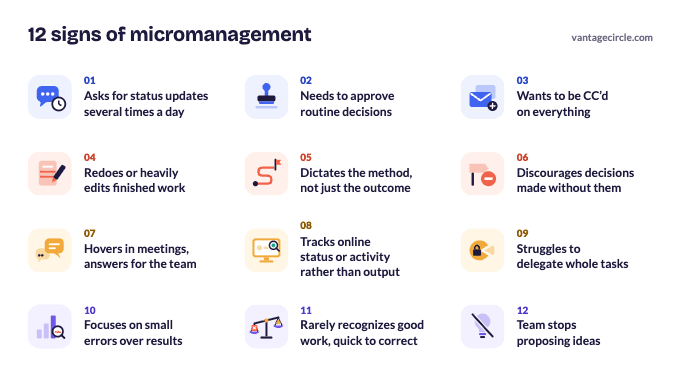
- Asks for status updates several times a day: pinging for progress on a task due end of week, every few hours.
- Needs to approve routine decisions: signing off on things like email wording that carry no real risk.
- Wants to be CC'd on everything: insisting on visibility into routine emails that do not need their input.
- Redoes or heavily edits finished work: rewriting a deliverable to match their own phrasing, not because it was wrong.
- Dictates the method, not just the outcome: prescribing the exact tool or steps instead of the result needed.
- Discourages decisions made without them: reacting badly when someone makes a reasonable call independently.
- Hovers in meetings, answers for the team: stepping in to answer questions directed at someone else.
- Tracks online status or activity rather than output: watching when someone is active instead of what they deliver.
- Struggles to delegate whole tasks: handing over pieces of a task while keeping the rest.
- Focuses on small errors over results: flagging a typo while ignoring that the work hit every target.
- Rarely recognizes good work, quick to correct: correction comes fast and often; recognition rarely does.
- Team stops proposing ideas: people stop raising new approaches because they expect to be overruled anyway.
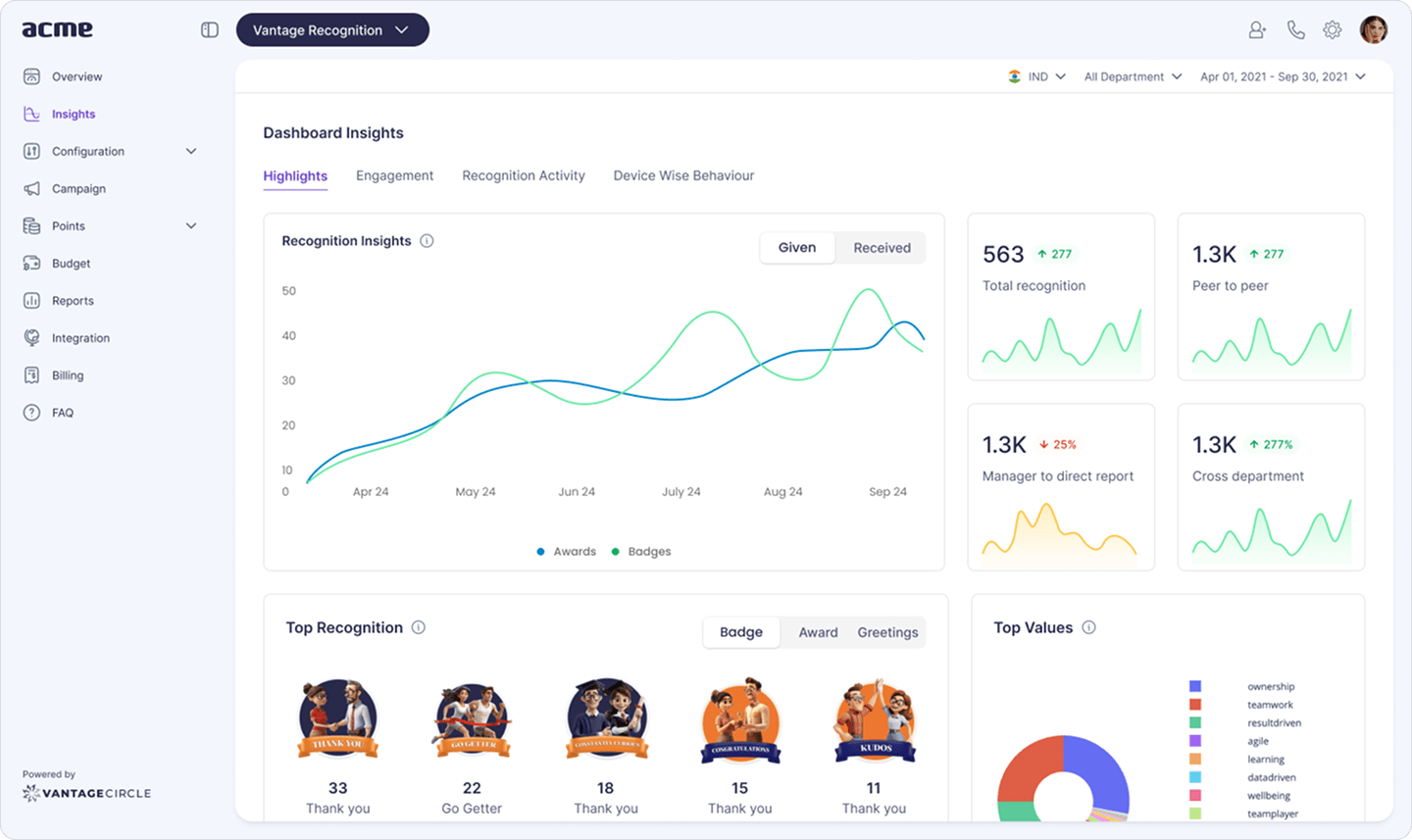
Sign 11 is one HR can measure instead of guessing at. Vantage Recognition's recognition analytics shows which managers rarely recognize their team, often the same group that corrects the most and delegates the least.
Micromanagement examples at work
Seeing the same situation handled two ways makes the line concrete.
| Situation | Micromanaging version | Healthy version |
|---|---|---|
| A report draft | Manager rewrites every paragraph in their own words before it goes out | Manager flags 2-3 substantive issues and lets the writer fix the rest |
| A client email | Manager insists on approving every email to that client first | Manager reviews the first few, then trusts the employee with the account |
| A sprint plan | Manager assigns each ticket personally and checks progress hourly | Manager agrees the sprint goal and lets the team self-assign tickets |
| A new hire's first week | Manager shadows every task indefinitely, long after week one | Manager shadows closely at first, then steps back on a set schedule |
| A remote workday | Manager tracks login times and active-status pings through the day | Manager checks in on agreed deliverables at the end of the day |
| A sales call | Manager insists on joining every call and directing it live | Manager joins occasionally to coach, lets the rep run most calls solo |
Why do managers micromanage?
Managers micromanage mainly because of anxiety about being held accountable, promotion for technical skill rather than leadership skill, unclear outcomes, and low trust.
Kanu Priya, Chief People Officer, India & APAC at Credera, described this on the Vantage HR Influencers Podcast: "Micromanagement is almost always a symptom... either trust was never extended, or ownership was never truly transferred. Fix those two, and the need to micromanage dissolves on its own." Harvard Business Review's 2023 analysis ties much of this to the manager's own anxiety about being blamed if something goes wrong on their watch, not a desire to control for its own sake.
There is also a structural cause. As Summer Davies explained on the same podcast, "often what micromanagement comes from is an individual who was promoted based on technical competence," and organizations assume technical skill will translate into leadership skill when the two are often unrelated. That new manager ends up overusing the skill they trust, technical expertise, to compensate for the leadership skill they have not yet built.
What personality is a micromanager?
There is no single micromanager personality. It is a behavior pattern, often linked to perfectionism and anxiety, not a fixed character trait. The same person can micromanage one project under pressure and delegate comfortably on another, which is why the fix targets the situation (trust, clarity, accountability) rather than trying to change someone's personality.
What micromanagement costs: effects on employees and teams
Micromanagement lowers autonomy, motivation and trust, and it raises stress, dependence and turnover risk.
Recognition research offers a useful proxy here. Vantage Circle's own research found that when even one of the four emotional recognition signals drops, workplace sentiment slips from 98% to 83%, motivation and retention fall by over 20 points, and discretionary effort nearly halves, according to The State of Recognition & Rewards 2025 (Vantage Circle). Micromanagement works directly against two of those feelings: being trusted to do the work right, and seeing the difference you made, since someone else keeps stepping in to redo or approve it. The study did not measure micromanagement itself, but the mechanism lines up closely with what it does to a team.
- Lost autonomy. Constant approvals remove the room employees need for their own judgment.
- Dependence. Without real delegation, employees lose confidence to decide things on their own.
- Burnout on both sides. Exhausting for the employee being checked on, and the manager doing the checking.
- Attrition. Eroded trust is one of the costliest routes to employee attrition.
- Slower decisions. When every call needs sign-off, work waits on the manager's calendar.
Left unaddressed, it can tip into a wider toxic work environment, especially paired with public criticism or no path to earn more autonomy, and it is one of the more direct routes to employee burnout, for the manager as much as the team.
Micromanagement or reasonable oversight?
Close supervision is reasonable when the situation genuinely needs it and has an end date. It becomes micromanagement when neither is true.
| Situation | Reasonable oversight | Tips into micromanagement when… |
|---|---|---|
| New hire (first 30-60 days) | Daily check-ins, shadowing key tasks | It continues long after they're proficient |
| Performance improvement plan | Defined milestones, regular review points | It extends beyond the plan's agreed scope |
| Safety- or compliance-critical work | Required sign-offs at each step | The same sign-offs apply to non-critical tasks too |
| Crisis or integration period | Tighter updates, with the reason explained | No end date is given for when it eases up |
| Stretch assignment | More coaching early, while skills build | The manager quietly takes the work back |
| Remote or hybrid work | An agreed check-in rhythm | Activity tracking replaces checking on outcomes |
Kanu Priya described this kind of time-boxed oversight during a post-acquisition integration: "It's always important to hold these open and transparent conversations with your team. Share why you are behaving the way you're behaving. Why do you need to be on top of it? And for how long?" That explanation, with an end date attached, is often what separates accepted oversight from micromanagement.
This matters just as much when managing remote employees, where the temptation to replace trust with visibility, tracking status or activity instead of outcomes, is exactly the shift that tips oversight into micromanagement.
Micromanagement vs. macromanagement
Micromanagement controls the how; macromanagement sets the what and steps back, sometimes too far.
| Dimension | Micromanagement | Macromanagement |
|---|---|---|
| Focus | The process and method | The outcome and the goal |
| Check-ins | Frequent, often unscheduled | Infrequent, sometimes too sparse |
| Decisions | Routed through the manager | Made by the employee |
| Risk | Burnout, low autonomy, attrition | Drift, missed problems, no support |
| Best for | New hires, safety-critical steps, short crises | Experienced, proven performers |
| Failure mode | Control that never eases up | Absence that leaves people unsupported |
The healthy middle sits between the two: outcome-based management with a clear check-in rhythm, built on genuine autonomy in the workplace, which both micromanagement and over-delegation take away in their own ways.
How to deal with a micromanager (for employees)
The most effective way to deal with a micromanager is to get ahead of their need for information and agree on outcomes and check-in times before they have to ask.
5 steps
- Pre-empt the updates. Send a short status note before they ask for one. Most micromanaging behavior is a response to uncertainty, so removing the uncertainty removes much of the reason to check in.
- Agree on outcomes and a check-in rhythm. Propose a specific cadence instead of leaving it open-ended, so updates happen on your terms.
- Ask what "done" looks like, up front. Clear success criteria before starting removes the ambiguity that invites a manager to step in mid-way.
- Show reliability on small things first. Trust builds in increments. Delivering consistently on lower-stakes work earns room to work more independently on bigger ones.
- Escalate if it persists. If the pattern does not ease even after you raise it directly, it is reasonable to escalate to HR or a skip-level manager.
What to say: word-for-word scripts
Scripts You Can Use
- Opening the conversation: "I want to make sure I'm meeting expectations. Could we agree on what 'done' looks like for this, so you don't need to check in as often?"
- Proposing a check-in rhythm: "Would a 15-minute check-in twice a week work, instead of updates as they come up? I'll flag anything urgent in between."
- Pushing back on being CC'd on everything: "I'll loop you in on anything that needs a decision from you. For routine updates, would a weekly summary work better than being CC'd on each one?"
- Escalating to HR or a skip-level: "I've tried agreeing on outcomes and check-ins directly with my manager, but the day-to-day oversight hasn't changed. I'd like to talk through how to raise this constructively."
If the issue is less about check-ins and more about how you are treated day to day, see dealing with a bad manager.
How to stop micromanaging (for managers)
To stop micromanaging, agree on the outcome, delegate the whole task, set fixed check-ins, and judge the result, not the route taken to get there.
- Define the outcome, not the steps. Agree on what success looks like and leave the method to the person doing the work.
- Delegate the whole task, not pieces of it. Keeping part of a task "just in case" is how micromanagement often hides inside otherwise reasonable delegation.
- Set fixed check-ins up front. Agree on a cadence before the work starts, so checking in does not feel driven by anxiety in the moment.
- Move up the delegation ladder deliberately. Most managers default to telling people what to do. Push a level further each time: tell, sell, consult, agree, advise, delegate.
- Judge the result, not the route. If the outcome is right, resist commenting on a method that simply differs from your own.
- Rebuild trust in the workplace deliberately. Trust is what makes delegation stick instead of reverting to control the first time something goes wrong.
One practical swap: for every correction you send, send one specific piece of appreciation too. Vantage Recognition's manager recognition tools make that swap visible, retraining attention from errors toward the contributions actually happening. That shift, kept up over time, is what real employee empowerment looks like, not a one-time announcement, but a manager who keeps choosing to step back.
The opposite of micromanagement: manage outcomes, recognize behaviors
The opposite of micromanagement is outcome-based management: clear expectations, agreed check-ins, and recognition of the behaviors you want more of.
Make expectations explicit
Vague expectations push managers back toward step-by-step control, since unclear outcomes are one of the root causes covered earlier. High-effectiveness programs are 2-3x more likely to codify and communicate recognition criteria than others, according to The State of Recognition & Rewards 2025 (Vantage Circle). Tagging recognition to specific company values, the way Vantage Recognition's core values alignment feature does, makes "what good looks like" visible, instead of something a manager has to spell out and police case by case.
Recognize what you observe, not every step
77% of high-effectiveness programs choose award recipients mainly on observed behaviors, compared with 27% of other programs, according to The State of Recognition & Rewards 2025 (Vantage Circle). That is the opposite of micromanaging: instead of tracking every step, a manager posts recognition when they see the behavior they want repeated. A visible feed, like Vantage Recognition's social recognition feed, lets the team see what good looks like without another status meeting.

How HR spots and coaches micromanagers
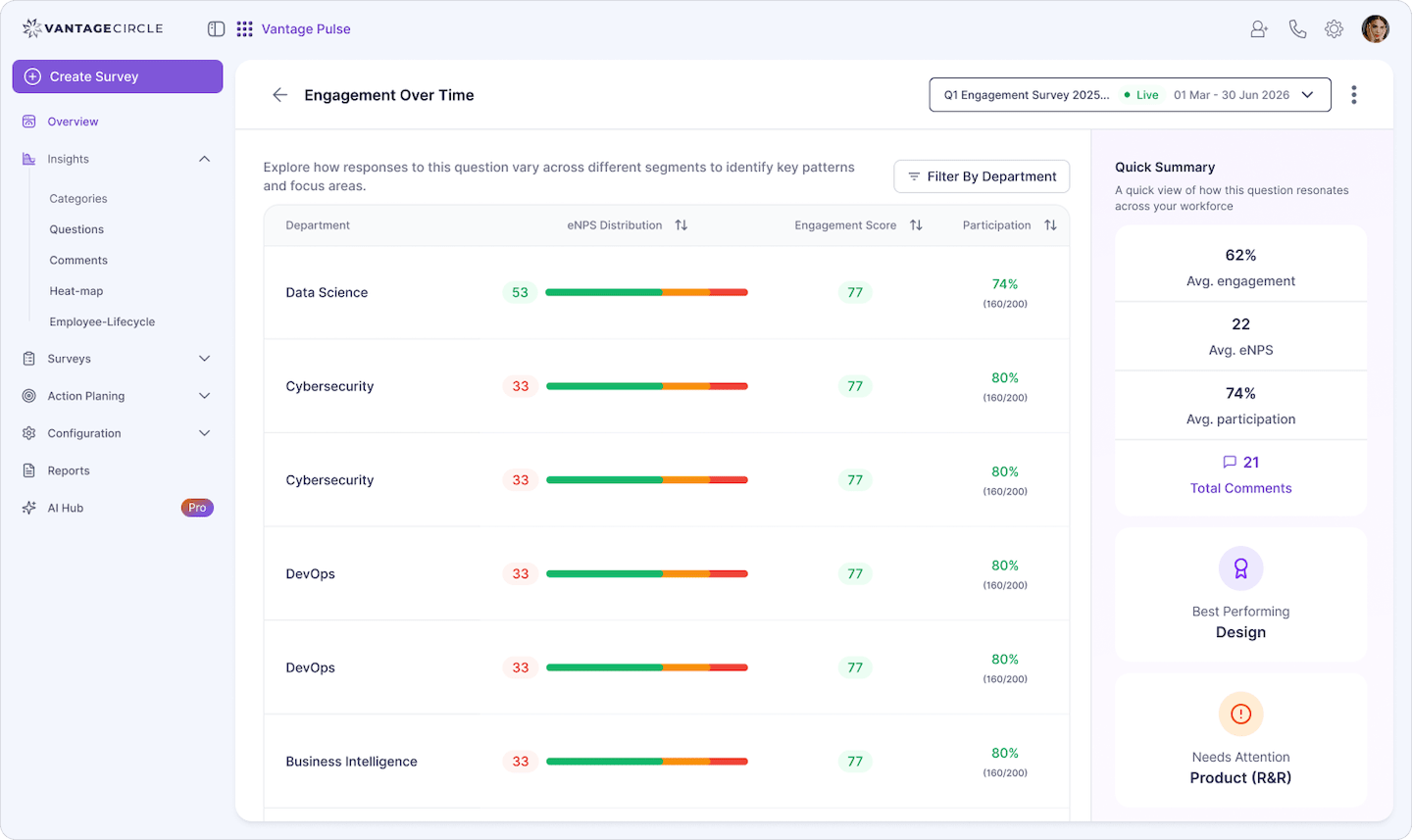
Micromanagement rarely shows up in an exit interview until it is too late. Adding two pulse questions, such as "I have the freedom to decide how I do my work" and "My manager trusts me to deliver," and comparing scores by team, tells HR exactly where to look. Vantage Pulse's department-wise insights make that comparison visible at a glance, flagging the team scoring well below the rest of the company on autonomy and trust.
People rarely write "my manager micromanages me" under their own name. Anonymous comments, read through sentiment analysis for themes like "constant check-ins" or "no ownership," surface the pattern while it is still coachable, not after someone has decided to leave.
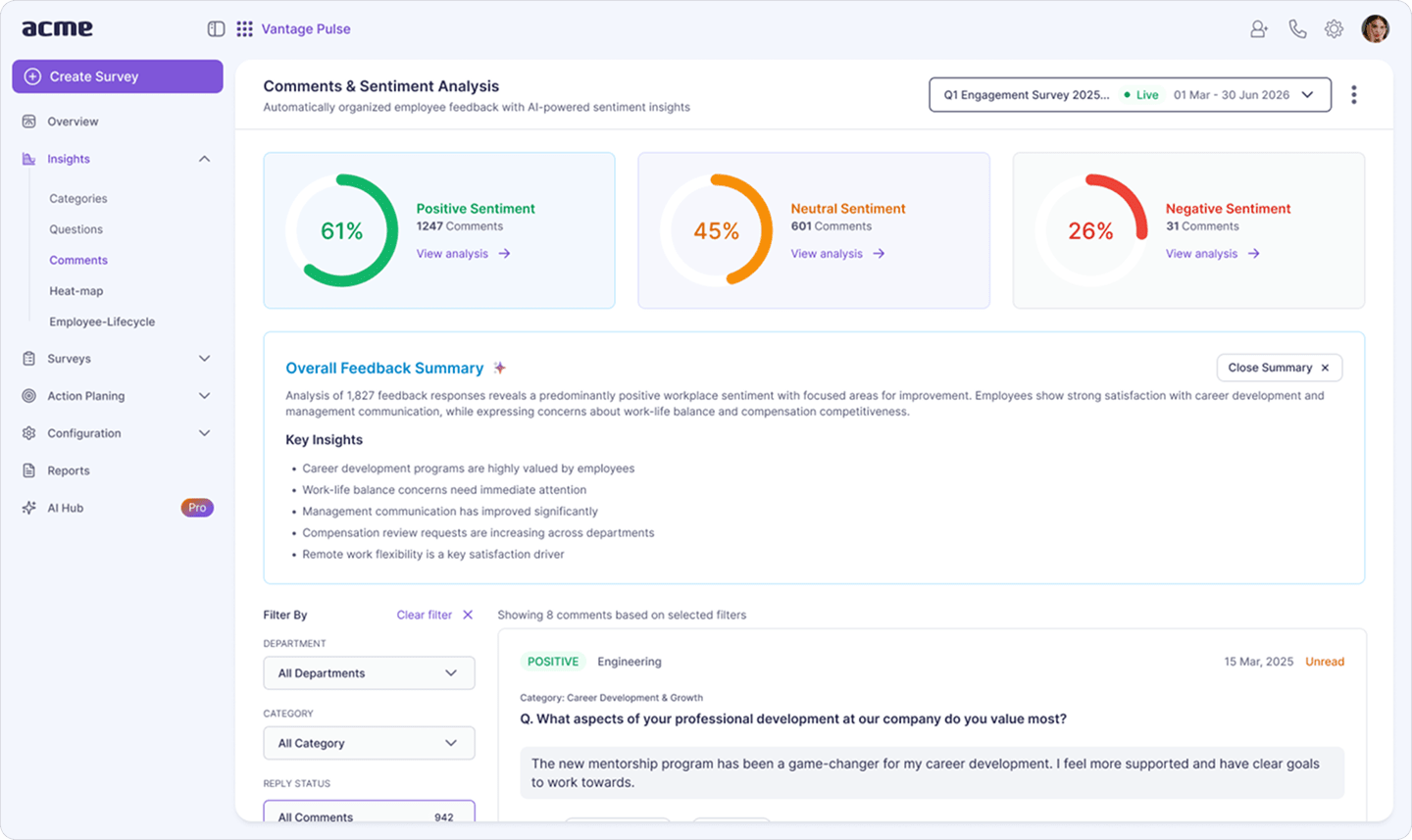
Once a pattern is visible, the fix is coaching, not punishment, which is also where a manager's role in employee engagement and psychological safety connect back to this topic.
Micromanagement quotes
These quotes capture why micromanagement backfires.
"Micromanage the process, not the people" – Joe Apfelbaum
"Invariably, micromanaging results in four problems: deceit, disloyalty, conflict, and communication problems." – John Rosemond
"Micro-managing creativity kills it." – Stewart Stafford
"None of us should wait to be told what to do, or how to do it. Micromanagement kills initiative, judgment, and creativity." – David H. Maister
"A boss who micromanages is like a coach who wants to get in the game." – Simon Sinek
"Micromanaging erodes people's confidence, making them overly dependent on their leaders." – Diane Dreher
"Micromanaging is ridiculous. There's always a certain amount of dynamic tension, which is good because it stimulates creative thinking." – Karin Uhlich
"Micromanagement is almost always a symptom." – Kanu Priya, Chief People Officer, India & APAC, Credera, on the Vantage HR Influencers Podcast
Conclusion
Micromanagement is rarely a character flaw. It is usually a symptom of unclear outcomes, unresolved anxiety, or trust that was never fully extended, which also means it is fixable. The 12 signs are not a verdict on anyone's character. They are a pattern to watch for, and the fix depends on where someone sits in it.
Employees push back with specific, low-drama scripts, not an argument about intent. Managers replace checking in on process with agreeing on outcomes, setting a real cadence for updates, and trusting the gap in between. HR puts recognition data, pulse surveys and manager coaching to work before this shows up in an exit interview.
None of this calls for less supervision. It calls for better supervision: judge the result, not the route, and let people prove they have earned room to get there their own way.
Frequently Asked Questions
What is the definition of a micromanager?
A micromanager is a manager who controls how work gets done in more detail than the employee needs, through frequent check-ins, required approvals and corrections, instead of agreeing on the outcome and letting the person get there their own way.
What is the difference between micromanagement and macro management?
Micromanagement controls the process, how work gets done, step by step. Macromanagement sets the outcome and steps back, trusting the employee with the method. The healthiest middle ground is outcome-based management with a clear check-in rhythm, not an all-or-nothing choice between the two.
How do I professionally say stop micromanaging me?
Frame it around outcomes, not the manager's behavior. Try: "I want to make sure I'm meeting expectations. Could we agree on what 'done' looks like for this, so you don't need to check in as often?" It proposes a solution rather than just naming the problem.
How not to micromanage employees?
Agree on the outcome rather than the steps, delegate the whole task instead of pieces of it, set a fixed check-in cadence up front, and judge the result instead of the method. Moving deliberately up the delegation ladder, from telling people what to do toward fully delegating, helps the shift stick.
What personality is a micromanager?
There is no single micromanager personality. It is a behavior pattern, often linked to perfectionism and anxiety, that can appear in one situation and not another for the same person. That is also why it is fixable: the fix targets the situation, not someone's character.
How do you shut down a micromanager?
Pre-empt their need for information with a short update before they ask, propose a specific check-in rhythm instead of leaving it open-ended, and show reliability on smaller tasks first to earn more room. If the pattern persists after you have raised it directly, escalate to HR or a skip-level manager.
Is micromanagement harassment?
On its own, micromanagement is generally not unlawful harassment under US federal law. It can become part of a harassment or hostile-work-environment claim when the excessive control is tied to a protected characteristic, such as race, sex, age or disability. This is general information, not legal advice; consult your HR team or an employment attorney if you believe that applies to your situation. For the broader pattern, see workplace harassment.
Is micromanagement ever a good thing?
Close supervision can be reasonable, not harmful, when the person or situation genuinely needs it and there is a clear end date, such as a new hire's first weeks or a short, explained crisis period. See the oversight-versus-micromanagement table above for how to tell the difference in practice.

Shaoni Gupta is a content marketing specialist at Vantage Circle, with expertise in scriptwriting and copywriting in the field of employee rewards and recognition.
Connect with Shaoni on LinkedIn.