Ask most HR leaders whether women at their company get a fair shot, and the answer is usually yes. Ask for the promotion rate into management by gender, or the pay gap by role, and the room goes quiet. Nobody is hiding anything. The numbers just haven't been pulled.
That gap between belief and data is where most of the problems in this guide sit. Women in the workplace still face a broken rung to their first promotion, a persistent pay gap and a gap in how often they are recognized, and HR can close each one.
This guide is for HR leaders and people managers. It covers the 10 challenges women face most often, 8 practical actions and the metrics that show whether anything is working. For the wider framework that covers every gender, see our guide to gender equality in the workplace.
Key Takeaways
- Women are about 49% of entry-level employees but 29% of the C-suite at participating US companies, and the biggest single drop is the first step into management.
- Women face 10 recurring challenges, from the broken rung and the pay gap to a recognition gap, the motherhood penalty and unsupported health needs.
- Each stage of a career has a different barrier, so one women's initiative rarely fixes all of them.
- The most effective support is structural: fix pay, promotion and recognition systems first, then add programs, and track results by gender every cycle.
Where Women in the Workplace Stand in 2026
Women remain under-represented at every step above entry level, and the biggest drop is at the first promotion to manager.
- Representation. Women hold 29% of C-suite roles at participating US companies, unchanged from 2024 (McKinsey & LeanIn, Women in the Workplace 2025).
- Promotion. For every 100 men promoted to manager, 93 women were promoted, and fewer still among women of color (same report).
- India. Women hold roughly 11-12% of managerial positions in India, against about 20% across Asia and the Pacific and 30.5% worldwide (ILO, Women in business and management: Scaling success, November 2026, using 2024 data for India).
- Pay. US women working full time, year-round earned 83.9% of what men earned in 2025, up from 80.6% in 2024 (US Census Bureau, September 2026). On hourly earnings across full- and part-time workers, the ratio was 85% (Pew Research Center, 2025, using 2024 data).
women promoted to manager for every 100 men
McKinsey & LeanIn · WIW 2025
of C-suite roles are held by women, unchanged from 2024
McKinsey & LeanIn · WIW 2025
of men's earnings: what US women working full time earned, 2025
US Census Bureau · Sept 2026
The two sources measure different things, annual full-time earnings and hourly earnings for everyone, but they agree on the story: the gap has narrowed, not closed.
Also read: Diversity and Inclusion Statistics
Glass ceiling vs broken rung
The glass ceiling is the invisible barrier near the top, where women stop advancing into senior leadership.
The broken rung is the first step from individual contributor to manager, where fewer women are promoted than men. Women who miss that step never catch up, because fewer of them are in the pool for every promotion above it.
10 Challenges Women Face in the Workplace
Each challenge below starts with a definition, shows what it looks like at work and ends with one action for HR.
1. The Broken Rung to First Promotion
The broken rung is the first step from individual contributor to manager, where fewer women are promoted than men, so the gap compounds at every level above.
In 2025, 93 women were promoted to manager for every 100 men, and the numbers for Black women (60) and for Asian women and Latinas (82) were lower still (McKinsey & LeanIn, 2025). The same report notes that only around one-third of entry-level people managers are women, so far more men are already on the path to promotion.
What HR can do
Audit first-line promotion rates by gender every cycle, and look at who was considered, not only who was promoted.
2. The Gender Pay Gap
The gender pay gap is the difference between what women and men earn, and it widens after parenthood.
US women working full time, year-round earned 83.9% of what men earned in 2025 (US Census Bureau, September 2026). Inside a company, gaps often sit in a handful of roles nobody checked. Our guide to how the gender pay gap affects your business covers the causes and costs.

Vantage Influencers Podcast
"Companies that are forward thinking are doing those pay equity studies and discovering if there is a problem. I remember when we first started doing this a few years ago, in the back of my mind, I thought this is not an issue at Axis. We pay women and men equally, only to find out that there were two, three, four jobs here, of which we had a number of people in those roles, where there was a disparity between what we were paying men and women. And we have fixed that."
Elaine Palome, Regional Head of Human Resources, Americas at Axis Communications
Listen to the EpisodeThat is one company's experience, but it shows why believing pay is fair is not the same as proving it.
What HR can do
Run a role-by-role pay-equity study every year, even if you believe there is no gap.
3. Women Are Recognized Less Often Than Men
The recognition gap is the difference in how often women and men feel recognized for their work, and recognition shapes who gets noticed for stretch roles and promotions.
It never shows up in a pay file or a promotion report. Vantage Circle and Great Place To Work India measured it in The Recognition Effect 2025, a study of 5.7M+ employee voices from organizations in India.
In 2025, 70% of men felt recognized at work, compared with 65% of women, a 5-point gap that the study describes as persistent.
Gender is not the only split. The same study found that recognition rises with rank (78% of senior leaders feel recognized, against 66% of non-supervisory employees), differs by generation (Gen Z 64%, Millennials 69%, Gen X 78%) and edges up with tenure (71% at five years or more, 69% for newer employees). These splits are reported separately, not for women specifically, but they point the same way: recognition follows access and visibility more than contribution.
Gaps like this hide in an engagement average and only show up when results are split by gender. The study shows an association, not a cause, but the link to visibility is easy to follow: a manager who recognizes some people more than others shapes who looks promotable. Our guide to the employee recognition gap covers the wider causes and costs. Vantage Recognition analytics show who is recognized, how often and by whom, so HR can see whether some groups are consistently missed before it turns into a promotion gap.
What HR can do
Check recognition data by team and level for who is, and isn't, being recognized. See how employee recognition programs can report this.
4. Bias and Double Standards
A double standard is judging women by different criteria from men for the same behavior: assertiveness reads as abrasive, and warmth reads as not leadership material.
Vantage Influencers Podcast
"The stereotypes sometimes persist because in the past, assertive women were punished for being assertive, which made the problem even worse by making assertive women even more rare. And that made assertiveness also look more masculine. And it's a self-sealing loop."
Elaine Palome, Regional Head of Human Resources, Americas at Axis Communications
Listen to the EpisodeThe way out is to replace a manager's sense of who seems like a leader with written, behavior-based criteria. Recognition tied to written company values works the same way: everyone is judged against the same behaviors. Our list of unconscious bias examples helps managers spot the patterns.
What HR can do
Score promotions against written, behavior-based criteria, and tie recognition to defined company values.
5. Too Few Sponsors
A sponsor is a senior person who puts your name forward for promotions and stretch work, which is different from a mentor, who gives advice.
In 2025, 31% of entry-level women had a sponsor, compared with 45% of entry-level men (McKinsey & LeanIn, 2025). Sponsors are usually chosen informally, so people who look like the current leaders tend to get them first.
What HR can do
Launch a formal sponsorship program with tracked outcomes, such as who was sponsored and who was promoted.
6. The Motherhood Penalty and Caregiving Load
The motherhood penalty is the drop in pay, promotion and perceived commitment that mothers face, which fathers typically do not.
A 2025 Minneapolis Fed study found that one year before a first child, future mothers earned 14% less than future fathers. In the year of birth the gap widened to 38%, and 11 years later it was 43%, mostly because mothers moved to lower-paying firms (Federal Reserve Bank of Minneapolis, August 2025). At home, women with partners were more than three times as likely as men with partners to be responsible for all or most housework in 2024 (McKinsey & LeanIn, 2025).
Flexible work is the usual answer, but it carries flexibility stigma: the belief that people who use it are less committed. The McKinsey & LeanIn report also found that women who worked mostly remotely were less likely to have a sponsor (37%, against 54% of women working mostly on-site) and less likely to have been promoted in the last two years (37%, against 53%). Men's rates stayed similar wherever they worked.
What HR can do
Make flexible work the default for everyone, so it carries no stigma, and check promotion rates for people who use it. Our guide to workplace flexibility covers how.
7. Pregnancy and Maternity Discrimination
Pregnancy discrimination is treating an employee or candidate unfavorably because of pregnancy, childbirth or a related condition.
In the United States, the Pregnant Workers Fairness Act (PWFA), in effect since June 27, 2023, requires employers with 15 or more employees to provide reasonable accommodations for known limitations related to pregnancy and childbirth unless it causes undue hardship. The Equal Employment Opportunity Commission (EEOC) issued its final rule in April 2024 (EEOC). In India, the Maternity Benefit Act, 1961, as amended in 2017, raised paid maternity leave to 26 weeks and requires a crèche in establishments with 50 or more employees (Press Information Bureau, Government of India). This is not legal advice, so check current provisions with your legal team.
Policy is the floor. What happens on return decides whether the break costs someone. Service milestones should count time on parental leave, so a career break never resets recognition history, whether those milestones sit in Vantage Recognition or another system.
What HR can do
Run a structured return-from-leave plan, and ask returners about it using our return-to-work survey questions.
8. Sexual Harassment and Microaggressions
Sexual harassment is unwelcome conduct of a sexual nature or based on sex, and microaggressions are the everyday slights that signal someone doesn't belong. Most incidents go unreported because people fear retaliation.
The EEOC's Select Task Force on the Study of Harassment in the Workplace found in 2016 that roughly three in four people who experienced harassment never talked to a supervisor, manager or union representative about it, and that only 6% to 13% filed a formal complaint (EEOC). The data is from 2016, but the lesson holds: a quiet complaints inbox tells HR little.
People report what they can report safely. Anonymous pulse questions about respect and fairness, read by department, help HR spot problems before anyone files a formal complaint, and Vantage Pulse supports anonymous responses. Our guides to workplace harassment, microaggressions in the workplace and women's safety at work go further.
What HR can do
Offer anonymous reporting and a no-retaliation guarantee, and publish what happened as a result.
9. Unsupported Health Needs: Menstruation and Menopause
Menstrual pain and menopause symptoms affect many women's work, yet few employers have a policy or train managers to talk about them.
In the UK, the CIPD's 2023 survey of more than 2,000 working women aged 40 to 60 found that 27% said menopause had a negative effect on their career progression, while only about a quarter (24%) said their organization had a stated menopause policy or other support in place (CIPD, Menopause in the workplace: Employee experiences in 2023).
A policy works better when wellness support backs it up, such as the corporate wellness programs in Vantage Fit.
What HR can do
Write a menopause and menstrual health policy, with guidance that helps managers hold the conversation.
10. Compounding Barriers for Women of Color
Women of color face the combined effect of gender and racial bias, and are the least represented group at senior levels.
In the pipeline data for 2025, women of color were 21% of entry-level employees but only 7% of the C-suite (McKinsey & LeanIn, 2025). An average for all women hides this, which is why metrics need to be split by gender and race together. Where a legal line is crossed, it becomes discrimination in the workplace.
What HR can do
Track promotion, pay and attrition at the intersection of gender and race, not only by gender.
Challenges by Career Stage
Each career stage brings a different barrier, so one women's initiative rarely fixes all of them.
Scroll to explore →
| Career stage | Common barrier | HR lever |
|---|---|---|
| Early career | Fewer entry-level women are on a manager path, and fewer have a sponsor (31% vs 45%) | Assign stretch work by skill, and match sponsors early |
| First promotion | The broken rung: 93 women promoted for every 100 men | Audit first-line promotion rates and use written criteria |
| Parenthood and caregiving | The motherhood penalty, flexibility stigma and an uneven load at home | Make flexible work the default and run a return-from-leave plan |
| Senior leadership | Fewer women in the pipeline, and the fewest women of color (7% of the C-suite) | Track pipeline by gender and race, and sponsor for senior roles |
| Late career and menopause | Unsupported health needs and fewer chances to advance | Write a menopause policy and keep development open to later-career women |
How HR Can Support Women in the Workplace: 8 Practical Actions
The most effective support is structural: fix pay, promotion and recognition systems first, then add programs. These 8 practical actions follow that order.
- Run a pay-equity audit every year. Compare pay for the same role, level and location, fix what you find and report the result to leadership.
- Use written criteria for promotions. Agree the behaviors and results that earn a promotion before anyone is considered, and score everyone against the same list.
- Launch a sponsorship program. Match senior people with employees they will put forward for stretch work, and track outcomes by gender, not just participation.
- Make flexible work the default, with no penalty for using it. Check that promotion and pay rates for people who use it match those of people who don't.
- Build a structured return-from-leave plan. Agree workload, check-ins and a path back to full responsibility before leave starts, and count leave toward service milestones.
- Write a menopause and menstrual health policy. Cover time off, adjustments and manager guidance, and back it with wellness support employees can use without asking permission.
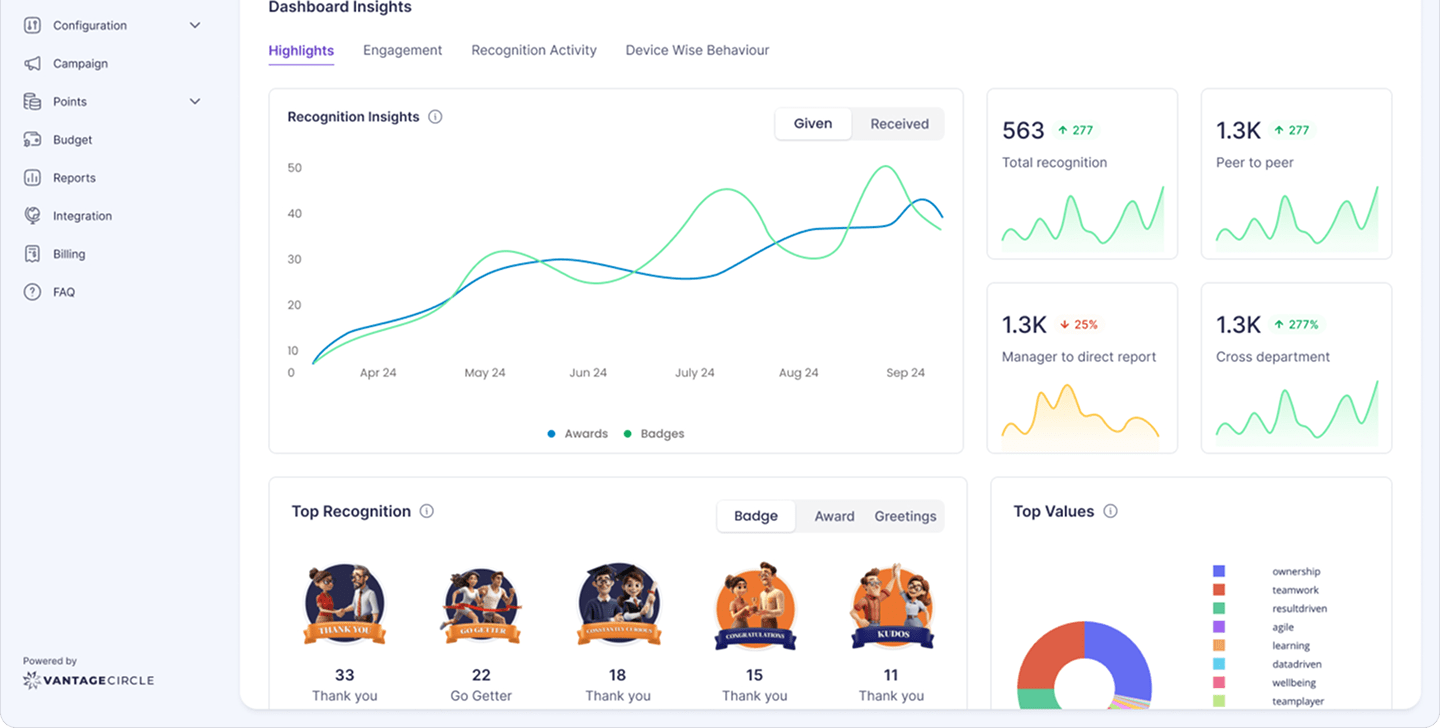
- Check recognition data for gaps by team and level. Peer recognition and a public feed widen the circle of people who notice good work, so visibility no longer depends on one manager. Look at who gives and who receives, then act on the groups being missed. Book a Vantage Recognition demo to see this in practice.
- Offer anonymous reporting with a no-retaliation guarantee. Show people what changed afterward, because silence after a report ends reporting.
Pay audits and promotion criteria fix outcomes, while flexibility, return plans and anonymous reporting build the psychological safety that makes people use them. For the full set of actions, see our 12 actions to promote gender equality.
How to Measure Progress for Women at Work
Track outcomes, not activity: promotion rates, pay gaps, recognition share and retention after leave, split by gender and level.
Scroll to explore →
| Metric | How to calculate | Warning sign |
|---|---|---|
| Promotion rate by gender | Promotions divided by eligible employees, by gender and level | Women are promoted to first manager at a lower rate than men |
| Adjusted pay gap by role | Median pay for the same role, level and location, by gender | A gap that tenure or performance can't explain |
| Share of recognition received | Each gender's share of recognition received versus its share of headcount | A group receives less recognition than its headcount predicts |
| Retention 12 months after parental leave | Returners still employed a year after coming back, by gender | Mothers leave at a higher rate than fathers in the year after leave |
| Representation by level | Share of each gender, and of women of color, at every level | The share of women falls at each step up |
| Exit reasons by gender | Coded reasons for leaving, by gender | Repeat mentions of bias, blocked growth or caregiving conflict |
Set a minimum group size before reporting any split, so no individual can be identified, and use the same definitions each cycle. Vantage Pulse breaks survey results down by department, so hotspots don't hide inside a company average.
Conclusion
The 10 challenges come down to a few systems: who gets promoted, who gets paid, who gets noticed and who gets support when life changes. Fix those, and most of the rest follows.
Start with the one you can measure fastest. Pull first-line promotion rates and recognition received, split by gender, and see what the numbers say before you design a single program.
Frequently Asked Questions
What are the challenges faced by women in the workplace?
The main challenges are the broken rung, the gender pay gap, a recognition gap, bias and double standards, too few sponsors, the motherhood penalty, pregnancy discrimination, harassment, unsupported health needs and compounding barriers for women of color.
How does sexism manifest in the workplace?
Sexism shows up in pay and promotion decisions, in who gets stretch assignments and sponsors, and in everyday behavior such as interruptions and doubts about commitment after parenthood. Most of it is routine rather than overt, so only a review of decisions by gender catches it.
What are some signs of misogyny at work?
Signs include demeaning comments about women, women's ideas being ignored until a man repeats them, penalties for assertiveness that men don't face, and harassment tolerated from high performers. A pattern, not a single event, separates misogyny from a bad moment.
What is subtle sexism?
Subtle sexism is unequal treatment that is easy to deny: being talked over in meetings, getting more office housework, or being called abrasive for behavior praised in men. Each instance looks small, but together they shape who gets promoted.
How to deal with a misogynist coworker?
Name the specific behavior calmly, write down dates and examples, and raise it with a manager or HR if it continues. Employers should act on patterns, offer anonymous reporting and apply conduct standards at every performance level.
How to prevent sexism?
Fix systems, not only attitudes: written promotion criteria, annual pay-equity audits, formal sponsorship, flexible work without penalty, recognition tied to defined values, and anonymous reporting. Training helps most alongside those changes.
What is the broken rung?
The broken rung is the first step up from individual contributor to manager, where fewer women are promoted than men: 93 women for every 100 men in 2025. The gap compounds at every level above it.

Lupamudra is a content marketing specialist at Vantage Circle, where she has written 50+ articles on employee recognition, rewards, and workplace culture, alongside employee engagement, diversity and inclusion, and HR compliance topics, including how India's tax rules apply to recognition and rewards programs.
Connect with Lupamudra on LinkedIn.