
In a 2024 Gartner survey of 407 marketing and cross-functional leaders, organizations with high "collaboration drag" (too many meetings, too much feedback, unclear decision rights) were 37% less likely to exceed their revenue and profit objectives. More collaboration isn't the fix. Better-designed collaboration is.
Team collaboration is when people pool their skills, information and judgment to produce a shared result that none of them could reach alone. Unlike teamwork, where tasks are divided and owned individually, collaboration means the work itself is shared: people build on each other's ideas, make decisions together and take joint credit for the outcome.
Most teams think they already collaborate. They share the same Slack channels, attend the same standups, and use the same project tool. But shared space is not shared work. When one person drives every decision and others react, that is not collaboration. That is a committee. The gap between the two determines whether your team solves hard problems or just processes decisions that someone else has already made.
This blog covers what collaboration actually is, which of the 6 types fits which task, how to build it in 6 steps, and an 8-signal scorecard to tell whether it is working.
Key Takeaways
- Team collaboration and teamwork are not the same: collaboration shares the work itself, not just the output.
- The 6 types are synchronous, asynchronous, virtual, cross-functional, formal and informal. Choosing by task rather than habit is the first discipline.
- The five most common failure modes are unclear ownership, low psychological safety, silos, tool overload and individual-only rewards.
- Collaboration is measurable through behavior: who helps whom, how decisions get made, whether recognition flows across teams.
What Is Team Collaboration?
Team collaboration is joint work where people contribute ideas and decisions together, rather than completing separate tasks in parallel.
The simplest way to separate it from teamwork: in teamwork, you divide the work and each person owns their piece; in collaboration, the work itself is shared and so is the result. A relay race is teamwork: each runner owns their leg. A jazz improvisation is collaboration: no one player owns the final sound. For more on where the two overlap and differ, see teamwork vs team building.
Collaboration depends on a specific set of interpersonal skills: active listening, the willingness to change your position when new information arrives, and giving credit to the people who made your idea better. These are learnable and worth developing deliberately rather than assuming they come with seniority.
Why Team Collaboration Matters
Collaboration matters because most work that drives results now crosses roles, so no single person has all the information.
Four benefits show up consistently when teams collaborate well.
Faster problem-solving. Diverse knowledge shortens the time from problem to solution. A team that includes the engineer, the customer-facing rep and the finance lead can usually catch a launch risk in one meeting that would take weeks of back-and-forth between silos.
Better decisions. When more than one perspective is in the room, the blind spots that derail decisions are more likely to surface before they become expensive.
Innovation. New ideas are almost always recombinations of existing ones. Collaboration creates the conditions for recombination by bringing knowledge from different parts of the organization into the same space.
Engagement and retention. People who feel that their contribution to a shared result is visible stay longer. That visibility is partly a recognition problem, and it is not yet solved in most organizations.
51% of companies rated their R&R programs highly effective or effective at embedding values and behaviors such as collaboration and innovation, according to The State of Recognition & Rewards 2025 (Vantage Circle).
That means roughly half of organizations rate their programs effective at reinforcing collaborative behavior by their own measure. The other half are hoping it happens on its own.
of companies rate their R&R programs effective at reinforcing collaborative behavior
Vantage Circle · SoRR 2025
of companies use spot awards for individuals only; fewer than half extend them to teams
Vantage Circle · AIRe India 2024-25
of high-effectiveness programs recognize both team and individual contributions
Vantage Circle · SoRR 2025
Also read: 5 Innovative Ways to Improve Teamwork in The Workplace
6 Types of Team Collaboration (and When to Use Each)
The 6 main types of team collaboration are synchronous, asynchronous, virtual, cross-functional, formal and informal. Most teams need a mix chosen by the task, not by habit.
These six types describe different dimensions of collaboration rather than mutually exclusive categories: when (synchronous, asynchronous), where (virtual), who (cross-functional) and how structured (formal, informal). A cross-functional project, for instance, can be virtual, asynchronous or both.
The table below gives each type a job description, its most common failure mode and the one ritual that prevents it.
Scroll to explore →
| Type | Best for | Failure mode | Ritual that makes it work | Signal to watch |
|---|---|---|---|---|
| Synchronous | Decisions, brainstorms, conflict resolution | HiPPO effect: the most senior voice ends the discussion early | Agree on the decision method before the meeting starts | Who speaks; who stays silent |
| Asynchronous | Review, research, drafting, global teams | Threads nobody closes; decisions made without full context | Every thread closes with a named owner and a date | Unread threads; missed response SLAs |
| Virtual | Distributed teams working across locations | Camera fatigue; remote participants excluded from live discussion | Collect remote input before any decision closes; async for updates | Participation rate on video calls |
| Cross-functional | Product launches, process changes, complex customer problems | One function dominates; others rubber-stamp the outcome | Rotating facilitation; shared document all functions own | Which function's view is missing from the final decision |
| Formal | Regulated processes, compliance, long projects with traceable ownership | Becomes bureaucratic; approval steps added but never removed | Review the structure quarterly; remove steps nobody uses | Approval bottlenecks; steps added over time |
| Informal | Quick problem-solving, knowledge sharing, trust building | Decisions made in the hallway; quieter people excluded from the loop | Document any informal decision that affects other people or changes an agreed course of action | Who is not in the informal network |
Synchronous collaboration
Synchronous collaboration happens in real time: a live meeting, a video call, a standing stand-up. It is best for decisions, brainstorms and conflict resolution, the moments where the back-and-forth matters. The most common failure mode is the HiPPO effect: the most senior voice in the room ends the discussion before everyone's input is in. Fix it by naming the decision method before you start: vote, consensus, or the team lead decides with input from the group.
Example
A product team holds a 45-minute sprint planning meeting. Before it starts, they agree that feature prioritization will be decided by a show-of-hands vote, with the product lead having a casting vote in a tie. No one person ends the conversation.
Asynchronous collaboration
Asynchronous collaboration happens on different clocks: a comment thread, a shared document, a voice memo sent at 11 p.m. It is best for review, research, drafting and coordinating across time zones. The failure mode is a thread that runs to 40 replies with no clear outcome. Fix it with a naming convention: every thread closes with a decision, a named owner and a next-action date.
Example
A content team reviews a brief in a shared document. Each reviewer adds comments. The writer resolves each comment with a note ("changed" or "kept, reason:") before the brief is finalized. The document is the record.
Virtual collaboration
Virtual collaboration uses digital tools to bridge physical distance. It includes both synchronous (video calls) and asynchronous (shared docs, chat) modes. The failure mode is remote participants being treated as an audience rather than contributors; they hear the decision but were not in the room where it happened. For distributed teams, see the remote team collaboration guide for deeper practices.
Example
A support team across two continents gives remote participants a written async channel to flag input before any decision closes on the weekly call, and uses voice notes for all status updates. Remote input collected before the decision; async for everything else.
Cross-functional collaboration
Cross-functional collaboration is when people from different departments work toward a shared output, where the result depends on each function's contribution.

Vantage Influencers Podcast
"You will have to collaborate with your team, you will have to collaborate with cross-functional team, where the collaboration and a democratic decision plays a vital role, because an initiative will be successful only when you have equal partnership from all functions."
Srividya Venkataramanan · Vice President HR, FSS
Listen to the EpisodeEqual partnership is the operative phrase. Cross-functional collaboration fails when one function makes the decisions while others attend the meetings. For the full definition and usage examples, see cross-functional.
Example
A product launch team with representatives from engineering, marketing, sales and customer success. The launch plan is authored by all four functions, not handed down from one and reviewed by the others.
Formal collaboration
Formal collaboration follows a defined structure: assigned roles, documented processes, scheduled reviews. It is best for regulated work, compliance-sensitive projects or long initiatives where ownership needs to be traceable. The failure mode is adding approval steps over time and never removing the ones nobody uses. Review the structure quarterly and cut what has become ceremony.
Example
A clinical trial team with a named principal investigator, a protocol review board and a standard weekly status report format that all members file to, regardless of which stage the trial is in.
Informal collaboration
Informal collaboration is the help people give each other without anyone scheduling it: a question answered in the corridor, a draft reviewed before it goes to the manager, a workaround shared in a chat thread. It is fast and costs nothing, but it excludes people who are not physically present or not in the informal network. Document any informal decision that affects other people or changes an agreed course of action.
Example
Two engineers resolve a build conflict in a ten-minute chat and document the decision in the ticket before end of day. The fix is fast; the record makes it visible.
What Gets in the Way of Team Collaboration
Collaboration usually fails for 5 reasons: unclear ownership, low psychological safety, silos, tool overload and individual-only rewards.
Each has a one-step fix that a team lead can apply without a program change.
- Unclear ownership. When everyone is responsible, no one is. The fix is a RACI for every project (see Step 2 below). Micromanagement is the flip side: it removes ownership without replacing it with clarity.
- Low psychological safety. People share half-formed ideas when they trust the room. Without psychological safety, collaboration produces polished answers to the wrong questions. The fix is modelling the behavior: the team lead shares an unfinished idea first.
- Silos. Teams that only recognize their own members stop sharing information across boundaries. Recognition that flows only within one team is an early signal of a silo forming. People rarely say "my manager takes credit for our work" out loud; anonymous pulse feedback is often the only way that barrier surfaces before it costs you someone.
- Tool overload. When a team uses six tools and nobody agrees which is authoritative, information gets lost between them. Use one tool per job type and write down which is for what (see Step 6).
- Individual-only rewards. When only individual performance gets credit, collaborative effort becomes invisible.
Collaboration vs competition: finding the balance
Some competition helps: it sets a standard; too much makes people hoard information rather than share it.
Competition at the team or business unit level can sharpen performance. Competition between people on the same team for the same reward typically undermines collaboration, and people stop sharing information when their peers are also their competitors.
The incentive design is where most programs get this wrong:
- Rewarding individual outcomes exclusively can discourage knowledge-sharing, since helping a peer may cost you a relative ranking.
- Ranking colleagues against one another tends to create information hoarding, particularly on skills or client insights that give someone a competitive edge.
- Recognizing both individual contributions and shared outcomes reinforces collaboration without eliminating accountability.
70% of companies use Spot Awards for individual contributors, but fewer than half extend them to teams, according to the AIRe Benchmarking Report India 2024-25 (Vantage Circle). Companies that reward individuals but not teams remove the incentive to share credit and ask for help. Design recognition programs to close that gap.
Read more: What Is Psychological Safety, Why It's Crucial, And Practical Ways To Improve It
How to Build Team Collaboration: 6 Steps
Build collaboration by making it safe to speak, clear who owns what, normal to disagree, and visible when people help each other.
For a broader look at how ways to improve teamwork connect to these steps, that guide covers team-level practices in depth.
1. Agree on a shared goal
Collaboration without a shared goal is just a meeting. Write the goal in one sentence that everyone on the team can recite: what you will deliver, by when and how you will know it worked. SMART goals for teamwork are a reliable format for this, particularly for teams that have struggled with vague mandates.
Example
"Ship the redesigned onboarding flow to production by March 31, reducing drop-off at step 3 from 42% to under 25%."
2. Define roles with a RACI chart
RACI (Responsible, Accountable, Consulted, Informed) is a one-page answer to "who does what." Responsible: does the work. Accountable: owns the outcome and signs off. Consulted: gives input before the decision. Informed: gets told after the decision is made.
Scroll to explore →
| Task | Responsible | Accountable | Consulted | Informed |
|---|---|---|---|---|
| User research | UX researcher | Product lead | CS team | Engineering lead |
| Flow redesign | UX designer | Product lead | Engineering lead, CS team | Marketing |
| Build and test | Engineering team | Engineering lead | UX designer | Product lead, CS team |
| Launch and comms | Marketing | Product lead | CS team | Engineering team |
3. Make it safe to speak up
People share ideas when they trust the room. Without psychological safety, your collaboration is a performance: people say what they think the team lead wants to hear. The standard for a safe team is not harmony; it is whether people can raise a problem before it becomes a crisis. The team communication guide has specific meeting practices that build this norm.
4. Set team rules for meetings, async work and disagreement
Norms travel fast and they degrade fast. Write them down. For meetings: who can decline, how long they run, how decisions are recorded. For async work: which tool is authoritative for which type of content, what a reasonable response time looks like. For disagreement: what a good challenge looks like versus a personal attack. See rules for teamwork and types of meetings for ready-to-use templates.
5. Credit the team, not just the hero
People keep collaborating when the help they give gets noticed.
Collaboration is mostly invisible work: the review someone did at 9 p.m., the context someone shared before a client call, the question someone answered that prevented three days of rework. When only the person who delivered the final output gets credit, the people who made it possible stop offering to help.
79% of high-effectiveness recognition programs recognize both the team and standout individuals when celebrating collective achievements, compared with 37% of other programs, according to The State of Recognition & Rewards 2025 (Vantage Circle).
According to a Vantage Circle case study, Tata Communications saw a 185% surge in peer-to-peer non-monetary recognition between FY2020 and FY2025 after making peer appreciation a consistent part of its recognition program. Peer-to-peer recognition is colleagues crediting each other's help, the kind of work that collaboration depends on.
Recognize the helper, not only the owner. After a shared win, name the people who unblocked the work: "This launched on time because [Name] caught the edge case in the data model and [Name] rewrote the brief the night before the client call."
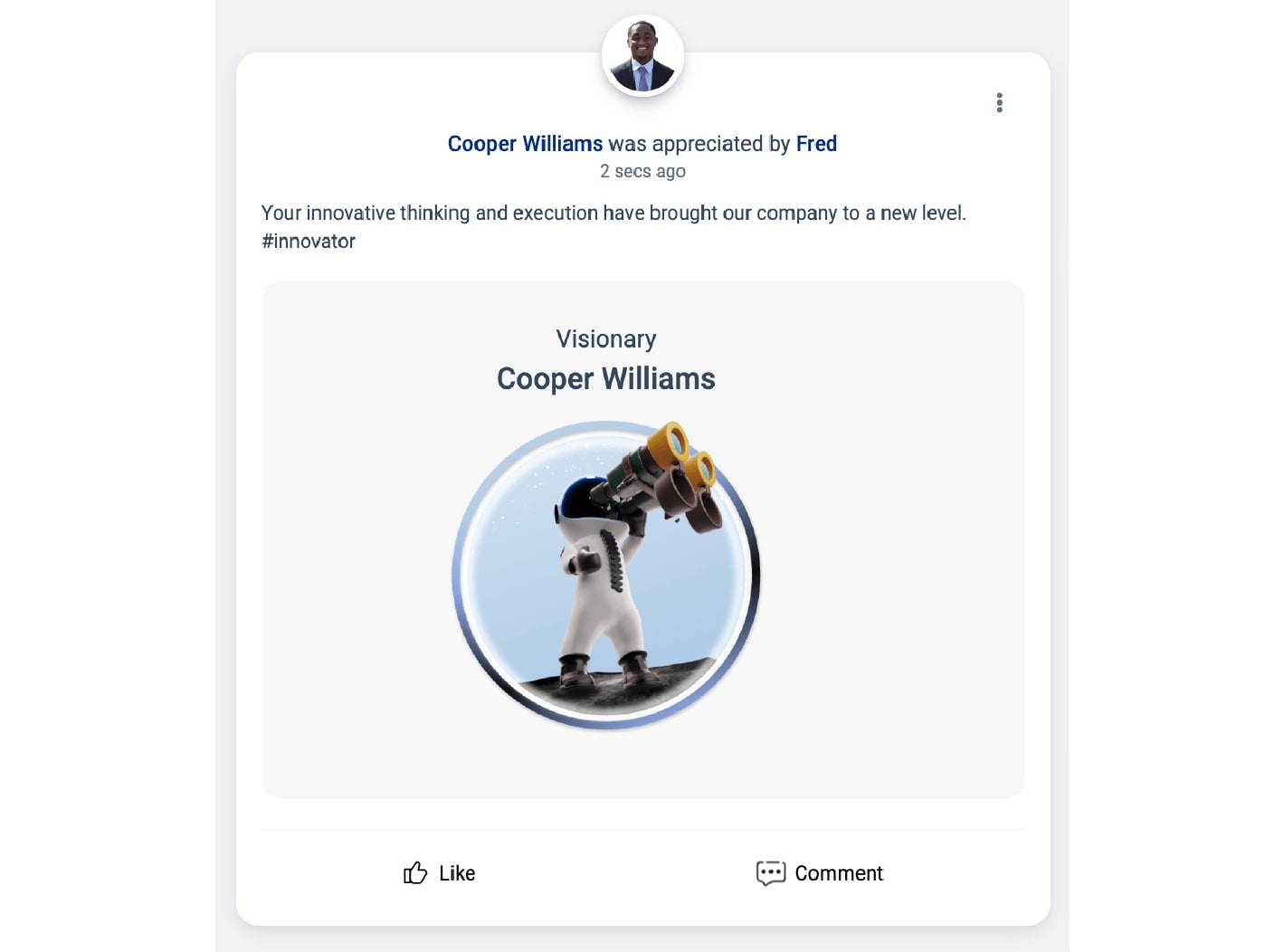
When a launch ships, one team award to the whole group says the result was shared, not just owned by whoever presented it. Pair it with a line naming the one or two people who unblocked the work, so the team and the standouts are both credited. That pairing is what high-effectiveness programs do differently.
Also read: Peer-to-Peer Recognition: Examples, Ideas, and How to Build a Program
6. Pick fewer tools and agree how to use them
Use one tool per job type and write down which is for what.
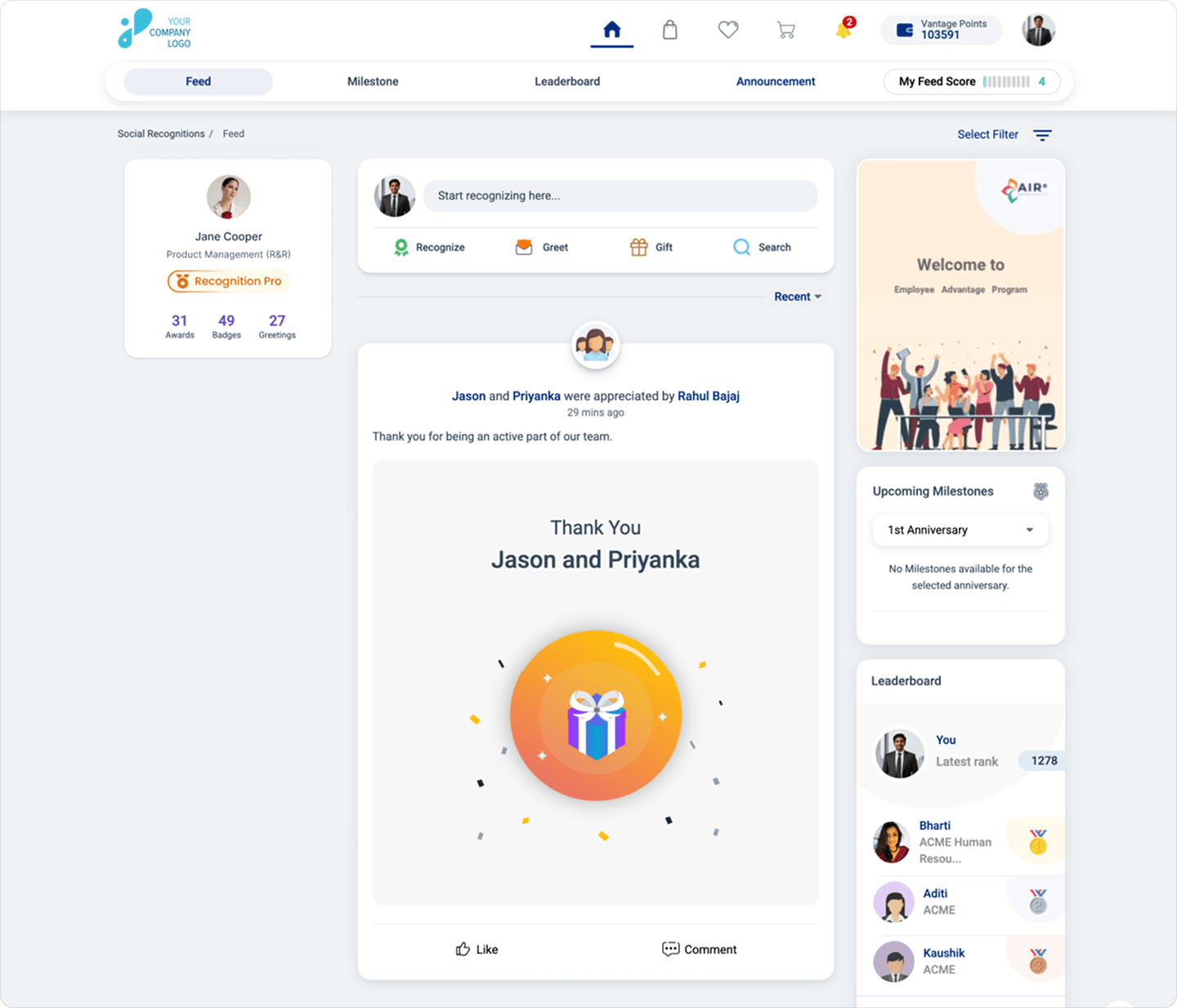
Tool overload is a collaboration killer. A team that uses chat, email, two project management tools and three shared drives will lose decisions in the gap between them. A simple rule: one tool for chat, one for documents, one for work tracking, one for video. When recognition lives inside the tools where the work happens (such as Teams or Slack), it takes ten seconds and does not add another window to the stack.
How to Measure Team Collaboration
Measure collaboration through behavior you can observe: who helps whom, how decisions get made, how fast blockers clear. Not through tool log-ins.
Log-in data tells you that people opened the tool. It says nothing about whether they worked together. The 8 signals below are observable and do not require a survey to track, though a pulse question added to your monthly check-in makes the trust signal quantifiable.
Scroll to explore →
| Signal | Where to see it | Red flag |
|---|---|---|
| Cross-team help requests answered | Ticket system; chat threads | Requests from other teams go unanswered for more than 2 days |
| Peer recognition flowing across teams | Recognition platform analytics | Recognition stays within one team only; no cross-department posts |
| Decisions documented with named owners | Meeting notes; project tool | Decisions made verbally with no written record |
| Blockers cleared within agreed SLA | Sprint board; ticket aging report | Tickets blocked for more than 3 days with no update |
| Meeting load per person | Calendar audit | More than 50% of work hours in meetings; no protected focus time |
| Voice share in key meetings | Observation; meeting recording | One or two people speak more than 60% of the time |
| Pulse survey trust score | Vantage Pulse or equivalent | Score on "I can ask another team for help and get it" drops month-over-month |
| Repeat-collaborator pairs | Recognition data; project history | Same two people always paired; no new collaborator relationships forming |
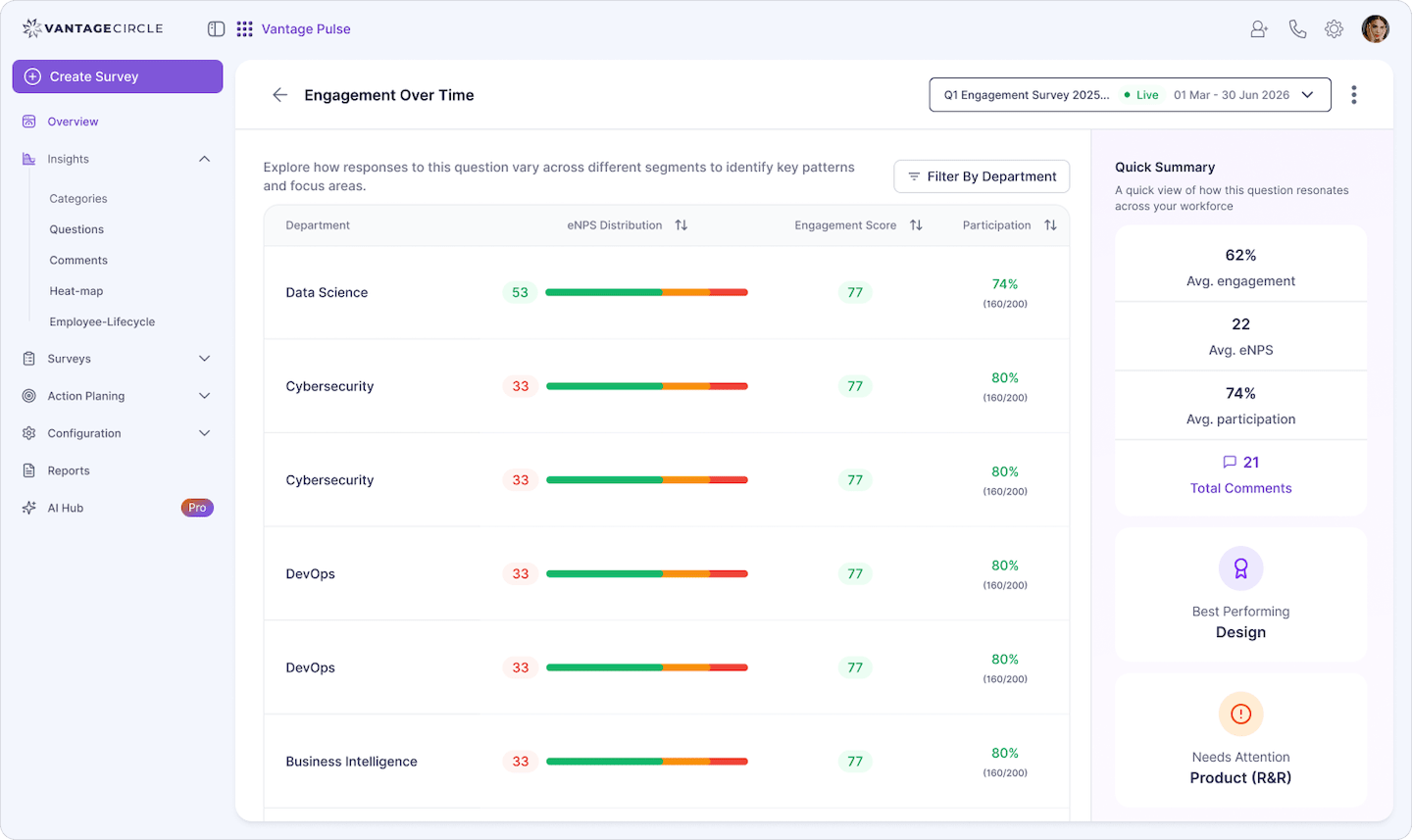
A two-question monthly pulse on cross-team help and conflict handling gives you a trend line by team. Recognition analytics that show cross-department flows are equally useful: recognition that stays inside one team is data, not just observation. That pairing shows which teams are drifting before it surfaces in exit interviews.
Team Collaboration Examples
Good collaboration looks different depending on the team type. The five illustrative examples below show situation, approach and likely outcome.
Product launch (cross-functional). Engineering, design, marketing and customer success review the user research together and co-write the success metric instead of handing specs from one team to the next. Blockers tend to surface weeks earlier, when there is still time to fix them, rather than the week before launch.
Support escalation (synchronous). A support rep facing a complex billing issue spanning three systems pulls in finance and engineering on a short call. Customers typically get an answer in minutes rather than waiting days for a ticket to route through each function separately.
Engineering code review (asynchronous). A backend team runs a rule: every pull request gets one comment from a reviewer in a different time zone before merge. Issues that would otherwise reach production tend to be caught at this stage, when the fix is still a comment rather than a rollback.
Shift handover on a factory floor (formal). An outgoing shift supervisor records a two-minute audio note on three open issues, the status of each and the named person carrying it forward. The incoming shift can start work immediately rather than spending the first 20 minutes reconstructing context from the previous team.
New-hire buddy pairing (informal). A new sales rep is paired with a senior rep for 90 days with no formal agenda. Early deal velocity tends to be higher when new hires have an informal channel for how the team actually operates, separate from the official onboarding materials.
Conclusion
Pick the right collaboration type for the task, make help visible and check the scorecard monthly.
The organizations that build lasting collaborative teams are the ones that make the help people give each other as visible as the results it produces. If your team is still forming, start with stages of team development. If recognition gaps are your most pressing issue, return to Step 5.
No collaboration program survives a culture that rewards only individual heroics. Collaboration isn't measured by how often people come together. It's measured by what they can accomplish together that they couldn't have accomplished alone.
Frequently Asked Questions
Is collaboration the same thing as teamwork?
No. Teamwork divides the work so each person owns a piece; collaboration shares the work so the result belongs to everyone. A relay race is teamwork. A jazz improvisation is collaboration. In practice, most teams need both: teamwork for execution and delivery, collaboration for decisions and problem-solving.
What are the stages of team development?
The five stages are forming, storming, norming, performing and adjourning, originally proposed by Bruce Tuckman in 1965, with the adjourning stage added in 1977. Collaboration is typically hardest in the storming stage, when roles and norms are still being negotiated. See stages of team development for how to move through each stage without stalling in storming.
What are the five Cs of effective collaboration?
One widely used version lists communication, coordination, cooperation, co-creation and celebration. There is no single standard list; different frameworks name different Cs. What most agree on is that effective collaboration requires clear communication, defined coordination mechanisms, genuine cooperation (not just compliance), space for ideas to build on each other, and recognition of the shared result.
What is another word for team collaboration?
Common alternatives include collective work, joint effort, cooperative work and co-creation. Each has a slightly different emphasis: joint effort stresses equal contribution; co-creation stresses that the output could not exist without all contributors; collective work is the most neutral of the group.
What is a stronger word than collaboration?
Co-creation and synergy are both stronger. Co-creation implies the output could not exist without all contributors. Synergy implies the result is greater than the sum of its parts. Both are more precise than collaboration, which covers everything from a quick shared document to a multi-year joint venture.
What is a professional word for teamwork?
In professional writing, collective effort, collaborative work and cross-functional coordination are standard alternatives. The right choice depends on context: collective effort works in HR writing; cross-functional coordination works in project documentation; collaborative work is the most neutral across both.
How can team collaboration be measured?
Measure it through the 8-signal Collaboration Health Scorecard above. The most reliable signals are cross-team help requests answered within SLA, peer recognition flowing across teams, decisions documented with named owners and voice share in key meetings. A monthly pulse question gives you a trend line by team without a full survey cycle.

Supriya is a Content Marketing Lead at Vantage Circle, where she writes on employee engagement, recognition, workplace communication, and culture. She spent the earlier part of her career in corporate communications at Burson, ESPN Star Sports, and CBRE, advising organizations on the messages employees actually hear.
Connect with Supriya on LinkedIn.


