
Keeping employees motivated and engaged isn't easy. And in today's competitive world, organizations can't afford to get it wrong.
That's where reward segmentation comes in. HR leaders and managers are turning to it as a smarter way to recognize their people.
Think about the people on your team. Some love being recognized in front of everyone. Others cringe at the spotlight and would much rather receive a personal thank-you or a reward they truly care about. And then there are those who just want flexibility, a day off, a perk that fits their lifestyle.
There's data to back this up.
According to Gallup, one of the most effective recognition is individualized to how each employee wants to be recognized.
So why are so many organizations still handing out the same reward to everyone?
Just like you'd tailor your approach for different customers, your employees deserve that same level of thought and care.
In this blog, we'll break down what reward segmentation is, why it matters, and how to build a strategy that genuinely works for your team.
What is employee reward segmentation?
Employee reward segmentation is the practice of grouping employees by shared characteristics (role, life stage, performance, preference) and matching each group with rewards that genuinely fit them, instead of giving the same reward to everyone.
It's a bit different from customer segmentation, which groups buyers by spending habits to drive sales. Reward segmentation is about understanding what motivates your people at work, so you can drive engagement, retention, and real effort.
The payoff is relevance. A cash bonus, an extra day off, a public shout-out, and a wellness credit are not interchangeable. They land very differently depending on who is receiving them. Gallup's research is clear.
When recognition matches how an employee wants to be recognized, it is far more likely to feel meaningful and far more likely to influence whether they stay.
Done well, segmentation turns a reward budget you already spend on disengaged employees into rewards employees actually value.
Related resource: What Is Personalized Recognition: Importance, Types & Ideas
Why reward segmentation matters (the business case)
Segmentation raises the ROI of rewards by routing every dollar to what each group actually values. Same budget, more relevance, more retention, fewer wasted
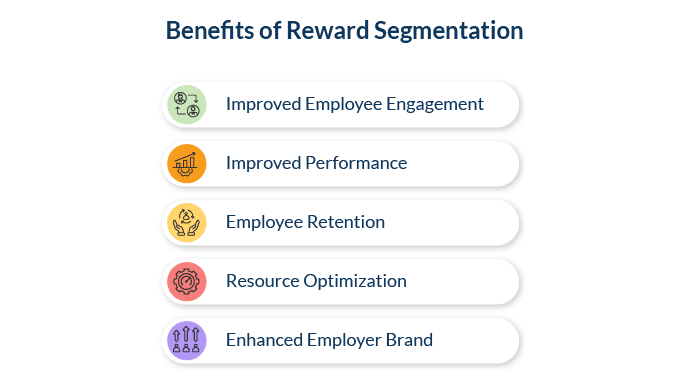
Three signals anchor the business case:
- Engagement is in free-fall, and rewards are part of the fix. Mercer's Global Talent Trends 2026 reports employee thriving dropped from 66% in 2024 to 44% in 2026, the lowest level since the measure was introduced in 2018. Modernizing pay and total reward practices is a 2026 priority for 39% of HR leaders.
- Personalization is now the table-stakes design choice. 67% of HR leaders in the same Mercer study say personalization of the employee experience will be critical in the next two years.
- Recognition that fits drives retention. Gallup (2024) finds employees whose recognition feels fulfilling are markedly more likely to stay and less likely to be actively job-hunting.
What different segments actually prefer (Vantage Circle platform data)
- Multi-geo workforces: Amdocs runs the platform across 26,000+ employees in 90+ countries at 95% redemption satisfaction; the 10,000+ option catalog removes the "nothing for me here" problem.
- Cross-currency teams: SOLI standardizes point value so a $50 award feels equivalent in New York, Bangalore, and Lagos.
- Across every segment: Vantage Circle's AIRe research (Personalization sub-driver) shows high-effectiveness programs blend mementos, experiential rewards, learning opportunities, and leadership interactions, not just gift cards.
- Choice-led catalogs: 1,000+ brands across gift cards, merchandise, digital content, and donations let each employee self-segment.
Net effect: with the same budget, segmented programs land more rewards employees actually value. That is what compounds into engagement and retention.
How to segment employees for rewards
Most teams need two or three lenses, not all five. Pick what your workforce actually varies on, then design rewards that match.
Demographic (age / generation)
Mid-career and senior employees lean toward retirement, healthcare, and family-focused benefits. Early-career employees lean toward learning, mentoring, and career-advancement perks. Treat this as a starting hypothesis to confirm with preference data, not a stereotype to act on.
Geographic (region / country)
Reward value is local. Work-life flexibility outweighs cash in some markets; in others, performance bonuses and prestige rewards land harder. SOLI-style equitable point conversion is the cleanest way to neutralize geography without rewriting the program.
Tenure and life stage
First-year hires need belonging and early wins. Five-year tenured employees value sabbaticals, milestones, and growth into leadership. New parents, relocating employees, and those nearing retirement each have distinct triggers worth recognizing.
Performance and role
A-players want stretch opportunities, leadership visibility, and accelerated recognition. Steady contributors value consistency, fairness, and predictable pathways. Role still matters: a sales win and an engineering ship require different rewards to feel earned.
Need-based and preference-based
Some employees are motivated by stability, others by mastery, others by purpose. The most accurate segmentation lets employees self-select (cafeteria or points-based programs) instead of HR guessing.
Segment-to-Reward matrix
| Segment | What they tend to value | Example reward | How to deliver it |
|---|---|---|---|
| Early-career | Growth, learning | Course credit, mentor time | Manager-nominated, public |
| Mid-career | Recognition + flexibility | Spot bonus + extra PTO | Peer-to-peer + manager-led |
| Senior leaders | Visibility, legacy, impact | Leadership platform, milestone | CEO-level, town hall |
| Multi-geo teams | Locally relevant value | SOLI-adjusted points, local catalog | Global program, local choice |
| High performers | Stretch, status | Performance bonus, accelerator | Manager + public ceremony |
| New parents / life events | Time, support | Extra PTO, care credits | HR-coordinated, private |
Segment: Early-career
What they tend to value: Growth, learning
Example reward: Course credit, mentor time
How to deliver it: Manager-nominated, public
Segment: Mid-career
What they tend to value: Recognition + flexibility
Example reward: Spot bonus + extra PTO
How to deliver it: Peer-to-peer + manager-led
Segment: Senior leaders
What they tend to value: Visibility, legacy, impact
Example reward: Leadership platform, milestone
How to deliver it: CEO-level, town hall
Segment: Multi-geo teams
What they tend to value: Locally relevant value
Example reward: SOLI-adjusted points, local catalog
How to deliver it: Global program, local choice
Segment: High performers
What they tend to value: Stretch, status
Example reward: Performance bonus, accelerator
How to deliver it: Manager + public ceremony
Segment: New parents / life events
What they tend to value: Time, support
Example reward: Extra PTO, care credits
How to deliver it: HR-coordinated, private
Don't try to segment on all five lenses at once. Start with the two that produce the biggest within-workforce variation, run them in a single program, and let employees opt in to the rest.
Employee Reward Segmentation Examples
The cleanest way to see segmentation work is by example. Below are five realistic scenarios, what the employee was actually carrying, and the reward that made the recognition land.
Example 1 · Early-career analyst
A 26-year-old data analyst just shipped her first big dashboard. Cash would have been polite. Visibility and growth landed harder.
Reward chosen: Six-month mentorship with a senior director plus a $300 learning credit. She kept telling that story for a year.
Example 2 · Remote / global engineer
An engineer in Lagos shipped a release alongside teammates in New York and Bangalore. A flat $200 USD bonus would mean three different things in three places.
Reward chosen: SOLI-adjusted points through each teammate's local catalog. Equivalent real-world value, no cross-geo math.
Example 3 · Long-tenure contributor
A program manager crossed her 10-year mark. A generic plaque would have read as a checkbox.
Reward chosen: A four-week paid sabbatical, a personal note from the CEO, and a $1,000 experience reward. Bigger retention signal than any raise.
Example 4 · High-performer
A sales lead closed the year 140% over quota. Commission was already paid.
Reward chosen: A stretch project, executive visibility, and headline placement at the next all-hands. Visibility was the multiplier.
Example 5 · Caregiving life stage
A new parent came back from leave. They needed flexibility and trust, not a public moment.
Reward chosen: Two weeks of flex PTO, on-demand backup childcare credits, and a private HR check-in. The message: we noticed the season you are in.
Worked-example matrix
| Segment | Scenario | Reward chosen |
|---|---|---|
| Early-career analyst | First major dashboard shipped | Senior-director mentorship + $300 learning credit |
| Remote/global engineer | Cross-geo release milestone | SOLI-adjusted points via local catalog |
| Long-tenure contributor | 10-year anniversary | 4-week sabbatical + CEO note + $1,000 experience |
| High-performer | 140% of sales quota | Stretch project + executive visibility + all-hands feature |
| Caregiving life stage | Returning from parental leave | Flex PTO + backup childcare credits + HR check-in |
Segment: Early-career analyst
Scenario: First major dashboard shipped
Reward chosen: Senior-director mentorship + $300 learning credit
Segment: Remote/global engineer
Scenario: Cross-geo release milestone
Reward chosen: SOLI-adjusted points via local catalog
Segment: Long-tenure contributor
Scenario: 10-year anniversary
Reward chosen: 4-week sabbatical + CEO note + $1,000 experience
Segment: High-performer
Scenario: 140% of sales quota
Reward chosen: Stretch project + executive visibility + all-hands feature
Segment: Caregiving life stage
Scenario: Returning from parental leave
Reward chosen: Flex PTO + backup childcare credits + HR check-in
Read more: Employee Rewards for Business Services: Recognition Strategies for 7 Industry Segments
What Is The Process Of Reward Segmentation?
Not sure how to implement reward segmentation? Don’t worry we got you covered.
Here’s a step-by-step guide you can follow-
1. Conduct Employee Surveys and Focus Groups
Surveys are a great tool to gauge deep into employee attitudes, preferences, and behaviors. The data collected from survey results will help you segment your employees into different sections.
However, if you are an organization with more than 8-10 employees, manually collecting and segmenting data can be daunting. In that case, use a survey tool to make the process easier and more efficient.
Make sure to choose a survey tool that helps you analyze the results in quantitative terms. Also, look for a tool that will allow you to analyze data category-wise, department-wise, and team-wise.
Take, for instance, Vantage Pulse, which offers robust visual reporting of the survey data in numerical form. Thus, it makes it easy to analyze and share survey findings with your teams in a clear and impactful way.
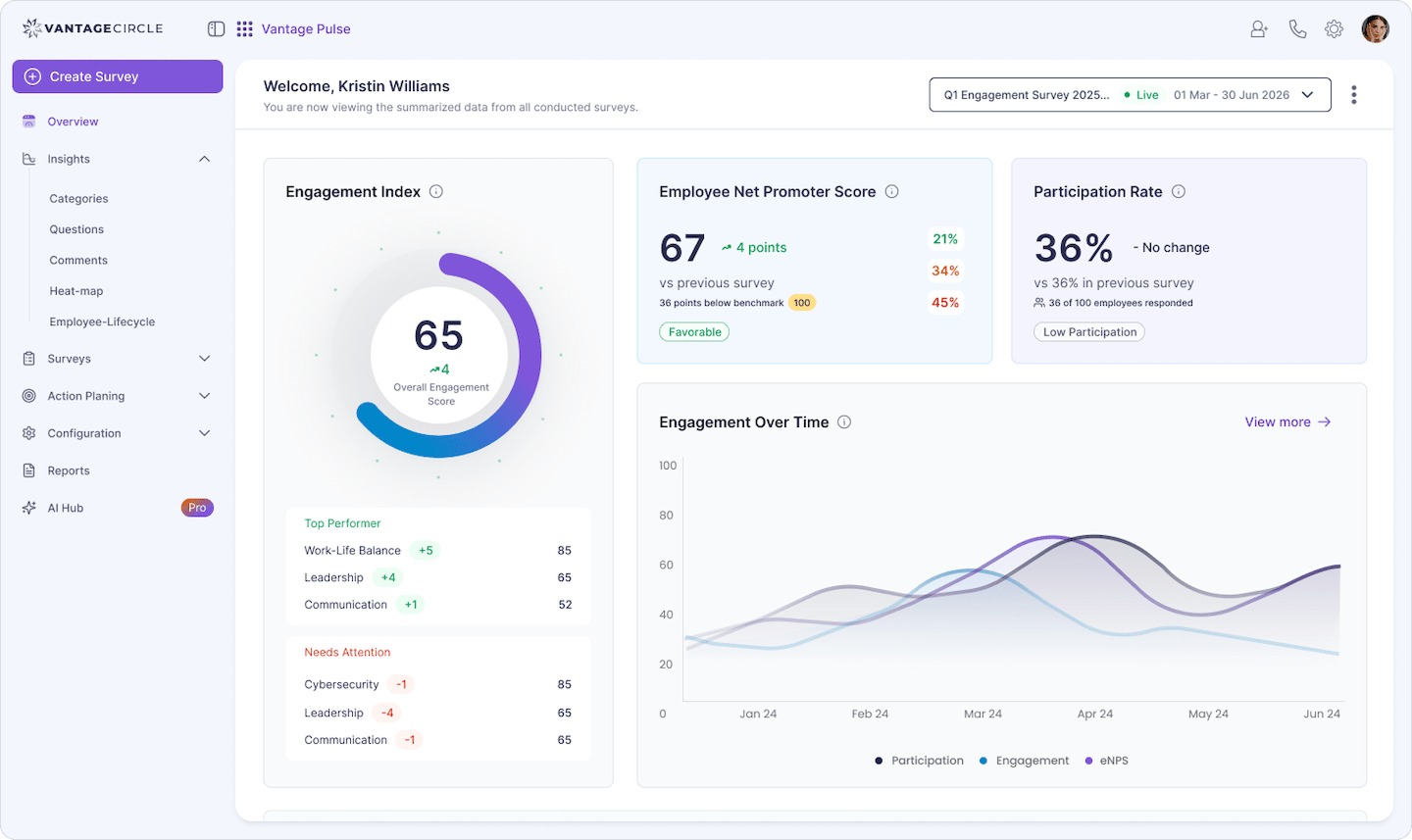
The next step will be to use this data to group employees based on common characteristics, their attitudes toward training and development needs, and more.
You can also organize focus groups to build upon the survey results and findings to gain deeper insight into employee perceptions and needs. These discussions will allow you to reach meaningful action-based results straight from employee ideas.
Keep pulse surveys short (5-7 questions max) and anonymous. Run preference questions separately from engagement questions so the signal stays clean. Then segment the results before you design any rewards, not after. Designing first and segmenting after means you build for an "average employee" who does not exist.
2. Create a Reward Segmentation Plan
Outline specific criteria for determining the reward segments. Identify the types of rewards and recognition that suit each segment best. For instance, for geo-based segmentation, you may consider the following:
- Cost of living
- Industry standards
- Local market conditions
Next, select the monetary and non-monetary rewards that align with the unique needs, characteristics, and challenges of each region.
Based on this data, prepare a reward segmentation plan.
The idea is to have a reward category for various performance-based segments. And if you want, you can keep adding more categories based on the changing employee/organizational dynamics. Just make sure that your plan is flexible enough to do that.
3. Collaborating with Senior Leaders

Communicate the results to your senior management and the key decision-makers.
I am sure, this will ensure a shared understanding of the objectives and framework of the reward segmentation plan. Leadership buy-in is also important to ensure the reward segmentation plan is practical, feasible, and aligns with your overall business strategy.
In addition, it will give you valuable pointers and improvements from the management before rolling out the plan in action.
Don't pitch segmentation to Finance as "added spend." Frame it as cost-of-disengagement avoided: same budget, redistributed to land harder. Bring last-year redemption data and the unredeemed-points liability to the conversation. CFOs sign off on better ROI, not on bigger budgets.
4. Run a Pilot
Before rolling out reward segmentation org-wide, test it on a smaller scale. You must design tailored reward packages for each segment and run a pilot project to see what actually works.
But there's a tricky part.
Tracking and measuring effectiveness across multiple groups can get messy fast.
Now, this is where the right platform makes all the difference. A tool like Vantage Recognition and Rewards, for example, gives you real-time visibility into which vouchers or gift cards get used most, and what employees are actually redeeming their points for. That kind of insight helps you catch misaligned rewards early, so you can fine-tune the plan before rolling it out to everyone.
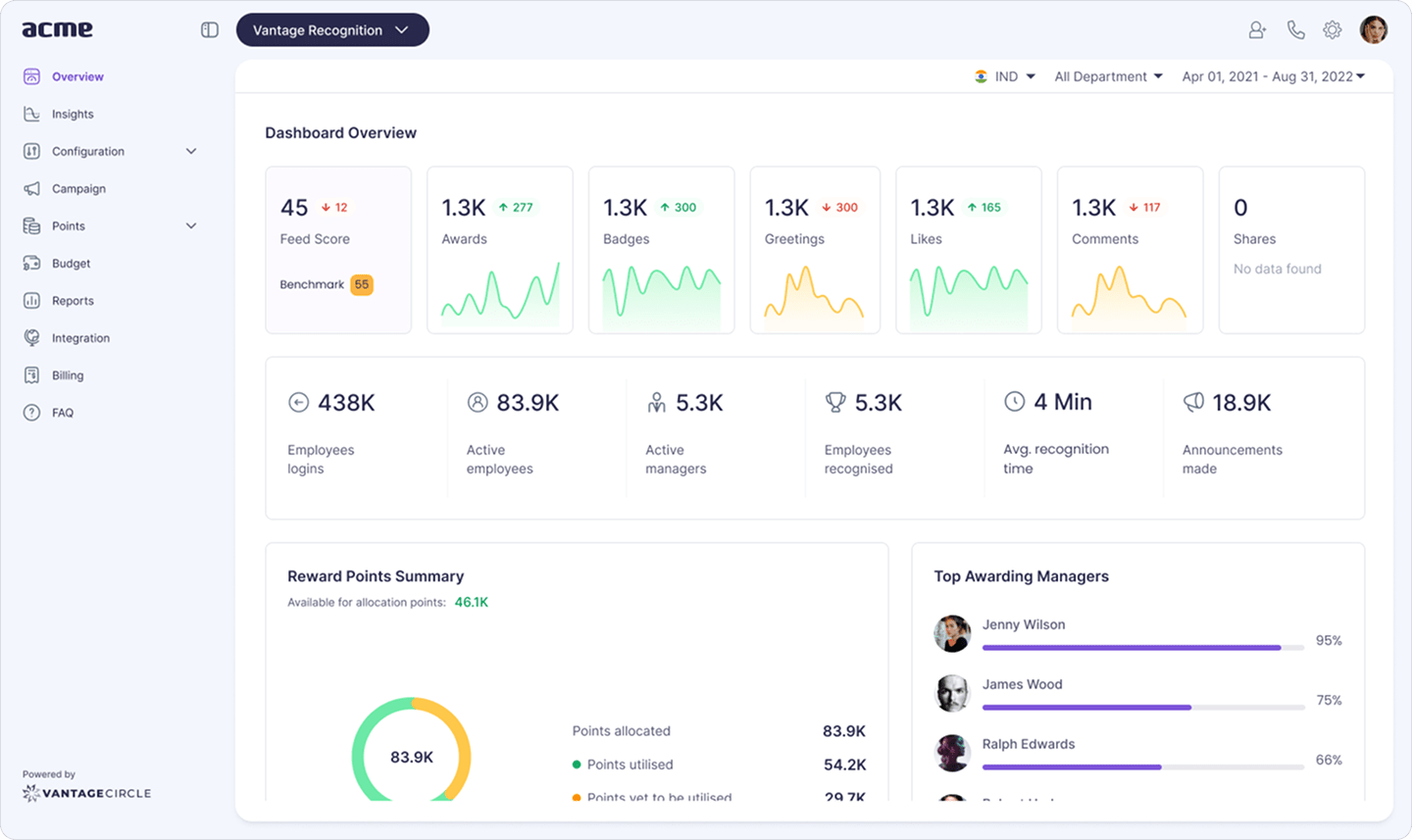
Run the pilot for 3-6 months minimum, and track leading indicators (recognition frequency per employee, redemption rate, feed engagement), not lagging ones like retention or eNPS, which take a year or more to shift. If recognition frequency hasn't moved within 90 days, the segmentation design is wrong, not the program itself.
5. Refining the Plan Based on Feedback
The next step is to gather feedback from the business units or employees who were part of the pilot project. Analyze the survey data to analyze what's working well and what needs to be worked on.
Use this data to refine the plan to ensure that it meets the needs and preferences of all your employees.
6. Scale Up
You are now ready to scale the plan across the organization. Also, make sure to keep evaluating, refining, and updating your employee reward segmentation plan so that it matches the changing employee needs and business goals.
VANTAGE INFLUENCERS PODCAST
"Organizations are investing more in people, better pay, broader benefits, more perks on paper."
— From the episode with Meera Mohandas, India Head of Rewards, Wipro
Listen to the EpisodeCommon Mistakes to Avoid
Most failed segmentation programs share the same handful of mistakes. Avoid these five and you will be ahead of most.
1. Over-segmenting
Slicing the workforce into eight or ten segments looks rigorous, but it creates an unmanageable matrix and confused employees. Start with two lenses. Add a third only when the first two are running cleanly.
2. Stereotyping
Treating "Gen Z wants flexibility, Boomers want stability" as a design rule, instead of a starting hypothesis, is how programs end up patronizing the people they are supposed to recognize. Confirm with preference data before you act.
3. Ignoring data
HR intuition is a useful tiebreaker, not a substitute for redemption data, survey signal, and engagement metrics. The platform already tells you what employees actually choose. Build segments around that, not around what you assume.
4. No pilot
Org-wide rollouts skip the cheapest learning. Test with one or two segments first, watch leading indicators for 90 days, fix what's broken, then scale.
5. Staying silent on the "why"
When employees compare notes and see different rewards with no visible logic behind them, segmentation reads as favoritism, not personalization. Publish the criteria you segment on, not the dollar amounts, so a colleague can see why a sabbatical went to one person and a spot bonus to another. Left unexplained, even a well-designed program turns into a trust problem.
Do Give a Read: 15 Common Employee Recognition Mistakes and How to Fix Them
Frequently asked questions
1. What is employee reward segmentation? (vs loyalty segmentation)
Employee reward segmentation is the practice of grouping employees by shared characteristics (role, tenure, life stage, preference) and matching each group with rewards that fit them, instead of giving the same reward to everyone. Customer loyalty segmentation, by contrast, groups buyers by spending behavior to drive transactions. Reward segmentation groups people by what motivates them at work to drive engagement and retention.
2. What are the main types of employee segmentation for rewards?
Five lenses cover most workforces: demographic (age and generation), geographic (region and country), tenure and life stage, performance and role, and need-based or preference-based. Most programs only need two or three of these to design well. Run them in a single program and let employees opt in to the rest.
3. What is a benefit segmentation example for employees?
A multi-geo engineer who shipped a release with teammates in New York, Bangalore, and Lagos. A flat $200 USD bonus would mean three different things in three places. The benefit-segmented version: SOLI-adjusted points redeemable through each teammate's local catalog, so the real-world value is equivalent across all three geographies.
4. How many employee segments should a rewards program have?
Start with two segments. Add a third only when the first two are running cleanly. Programs that ship with eight or ten segments at launch create an unmanageable matrix and confused employees. The right number is the smallest count that captures the biggest within-workforce variation, usually two or three.
5. How do you measure if reward segmentation is actually working?
Track leading indicators, not lagging ones: recognition frequency per employee, redemption rate, and feed engagement. These move within weeks. Retention and eNPS are lagging indicators that can take a year or more to shift, so they're too slow to tell you whether a segment's reward design needs fixing. If recognition frequency hasn't moved within 90 days of launch, the segmentation design is wrong, not the program itself.
Finally
Well, the reward preferences of employees have changed. To meet these changing employee expectations, employee reward segmentation is a great initiative you can use.
But as I mentioned earlier, it's not everyone's cup of tea due to its complex and variable processes. In that case, add flexibility to your structures instead of creating different reward structures for each employee segment. The decision is up to you.
So, what's your take on it?

Sanjeevani Saikia is a Senior Content Strategist at Vantage Circle, where she leads end-to-end content strategy across SEO, thought leadership, brand storytelling, podcasts, and video. She is also the host of the Vantage Influencers Podcast, where she brings conversations with HR and business leaders from top global organisations, including Fortune 500 companies.
Connect with Sanjeevani on LinkedIn.